Updated PDF (New 2026) Actual Microsoft DP-420 Exam Questions [Q14-Q35]

Rate this post

Updated PDF (New 2026) Actual Microsoft DP-420 Exam Questions

Verified DP-420 Exam Dumps PDF [2026] Access using It-Tests

QUESTION 14
You have an Azure Synapse Analytics workspace named workspace1 that contains a server less SQL pool.
You have an Azure Table Storage account that stores operational data.
You need to replace the Table storage account with Azure Cosmos DB for NoSQL The solution must meet the following requirements:
* Support Queries from the server less SQL pool.
* Only pay for analytical compute when running queries.
* Ensure that analytical processes do
NOTE: affect operational processes.
Which three actions should you perform in sequence? To answer, move the appropriate actions from the list of actions to the answer area and arrange them in the correct order.

QUESTION 15
You have a container named container1 in an Azure Cosmos DB Core (SQL) API account. Upserts of items in container1 occur every three seconds.
You have an Azure Functions app named function1 that is supposed to run whenever items are inserted or replaced in container1.
You discover that function1 runs, but not on every upsert.
You need to ensure that function1 processes each upsert within one second of the upsert.
Which property should you change in the Function.json file of function1?


QUESTION 16
You have an Apache Spark pool in Azure Synapse Analytics that runs the following Python code in a notebook.

For each of the following statements, select Yes if the statement is true. Otherwise, select No.
NOTE: Each correct selection is worth one point.

QUESTION 17
You have an Azure Cosmos DB for NoSQL account that has multiple write regions.
You need to receive an alert when requests that target the database exceed the available request units per second (RU/s).
Which Azure Monitor signal should you use?


QUESTION 18
You have a container named container1 in an Azure Cosmos DB Core (SQL) API account.
The following is a sample of a document in container1.
{
“studentId”: “631282”,
“firstName”: “James”,
“lastName”: “Smith”,
“enrollmentYear”: 1990,
“isActivelyEnrolled”: true,
“address”: {
“street”: “”,
“city”: “”,
“stateProvince”: “”,
“postal”: “”,
}
}
The container1 container has the following indexing policy.
{
“indexingMode”: “consistent”,
“includePaths”: [
{
“path”: “/*”
},
{
“path”: “/address/city/?”
}
],
“excludePaths”: [
{
“path”: “/address/*”
},
{
“path”: “/firstName/?”
}
]
}
For each of the following statements, select Yes if the statement is true. Otherwise, select No.
NOTE: Each correct selection is worth one point.

QUESTION 19
You have a database named db1 in an Azure Cosmos DB for NoSQL
You are designing an application that will use dbl.
In db1, you are creating a new container named coll1 that will store in coll1.
The following is a sample of a document that will be stored in coll1.

The application will have the following characteristics:
* New orders will be created frequently by different customers.
* Customers will often view their past order history.
You need to select the partition key value for coll1 to support the application. The solution must minimize costs.
To what should you set the partition key?


QUESTION 20
You are developing an application that will connect to an Azure Cosmos DB for NoSQL account. The account has a single readme region and one agonal read region. The regions are configured for automatic failover.
The account has the following connect strings. (Line numbers are included for reference only.)
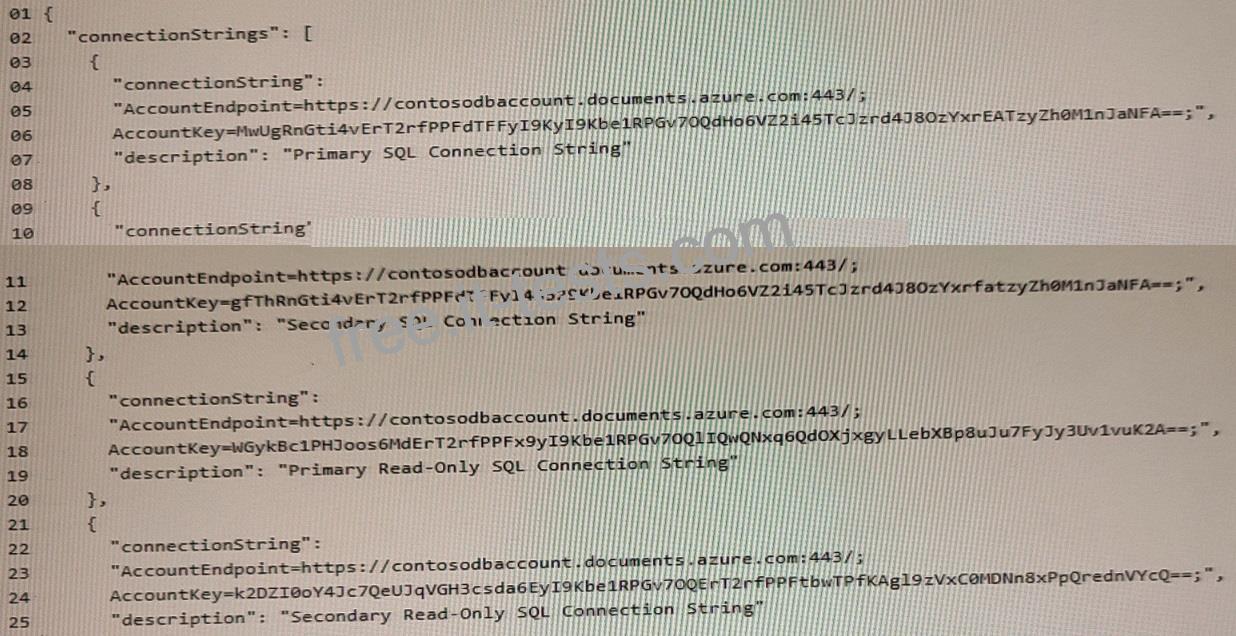
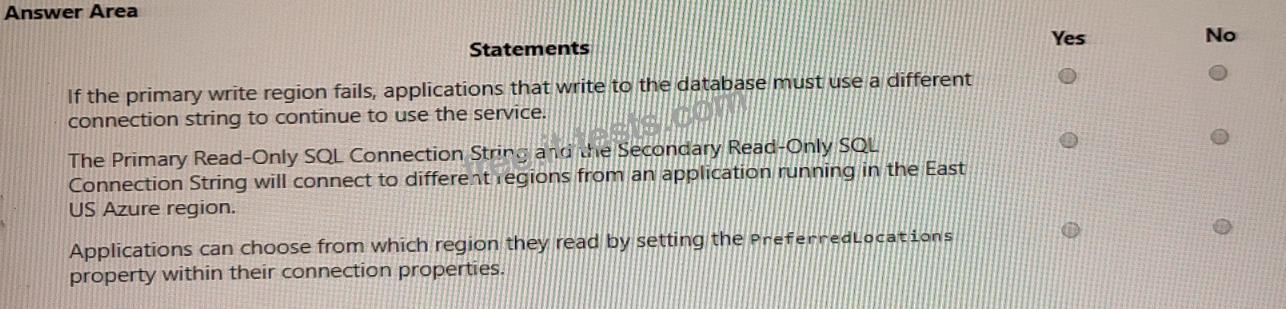
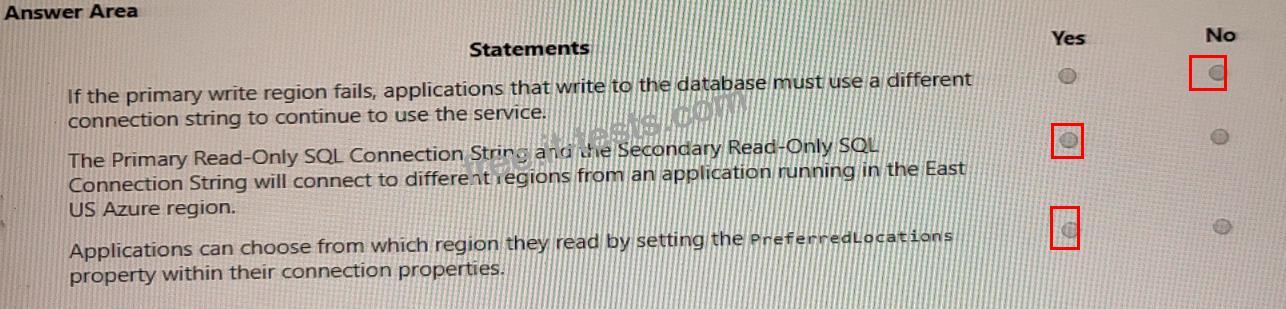
For each of the following statements, select Yes if the statement is true. otherwise, select No.
NOTE: Each correct selection is worth one point.
QUESTION 21
The following is a sample of a document in orders.

The orders container uses customer as the partition key.
You need to provide a report of the total items ordered per month by item type. The solution must meet the following requirements:
Ensure that the report can run as quickly as possible.
Minimize the consumption of request units (RUs).
What should you do?


QUESTION 22
You have an Azure Cosmos DB account named account1 that has a default consistency level of session.
You have an app named App1.
You need to ensure that the read operations of App1 can request either bounded staleness or consistent prefix consistency.
What should you modify for each consistency level? To answer, select the appropriate options in the answer area.
NOTE: Each correct selection is worth one point.

QUESTION 23
You have the indexing policy shown in the following exhibit.

Use the drop-down menus to select the answer choice that answers each question based on the information presented in the graphic.
NOTE: Each correct selection is worth one point.

QUESTION 24
You have a database in an Azure Cosmos DB for NoSQL account. The database contains a container named container1. The indexing mode container1 is set to none. You configure Azure Cognitive Search to extract data from container1 and make the data searchable. You discover that the Cognitive Search index is missing all the data from the Azure Cosmos DB index. What should you do to resolve the issue?


QUESTION 25
You have an Azure Cosmos DB for NoSQL account that frequently receives the same three queries.
You need to configure indexing to minimize RUs consumed by the queries.
Which type of index should you use for each query? To answer, select the appropriate options in the answer area.
NOTE: Each correct selection is worth one point.

QUESTION 26
You configure Azure Cognitive Search to index a container in an Azure Cosmos DB Core (SQL) API account as shown in the following exhibit.

Use the drop-down menus to select the answer choice that completes each statement based on the information presented in the graphic.
NOTE: Each correct selection is worth one point.

QUESTION 27
You have an Azure Cosmos DB for NoSQL account named account1 that has a single read-write region and one additional read region. Account1 uses the strong default consistency level.
You have an application that uses the eventual consistency level when submitting requests to account1.
How will writes from the application be handled?


QUESTION 28
You plan to implement con-iot1 and con-iot2.
You need to configure the default Time to Live setting for each container. The solution must meet the loT telemetry requirements.
What should you configure? To answer, select the appropriate options in the answer NOTE: Each correct selection is worth one point.

QUESTION 29
You have operational data in an Azure Cosmos OB for NoSQL database.
Database users report that the performance of the database degrades significantly when a business analytics team runs large Apache Spark-based queries against the database.
You need 10 reduce the impact that running the Spark-based queries has on the database users.
What should you implement?


QUESTION 30
Note: This question is part of a series of questions that present the same scenario. Each question in the series contains a unique solution that might meet the stated goals. Some question sets might have more than one correct solution, while others might not have a correct solution.
After you answer a question in this section, you will NOT be able to return to it. As a result, these questions will not appear in the review screen.
You have a container named container1 in an Azure Cosmos DB Core (SQL) API account.
You need to make the contents of container1 available as reference data for an Azure Stream Analytics job.
Solution: You create an Azure Synapse pipeline that uses Azure Cosmos DB Core (SQL) API as the input and Azure Blob Storage as the output.
Does this meet the goal?


QUESTION 31
You have a database in an Azure Cosmos DB for NoSQL account that is configured for multi-region writes.
You need to use the Azure Cosmos DB SDK to implement the conflict resolution policy for a container. The solution must ensure that any conflict sent to the conflict feed.
Solution: You set ConfilictResolutionMode to Custom and you use the default settings for the policy.
Does this meet the goal?


QUESTION 32
You have a container named container1 in an Azure Cosmos DB Core (SQL) API account. Upserts of items in container1 occur every three seconds.
You have an Azure Functions app named function1 that is supposed to run whenever items are inserted or replaced in container1.
You discover that function1 runs, but not on every upsert.
You need to ensure that function1 processes each upsert within one second of the upsert.
Which property should you change in the Function.json file of function1?


QUESTION 33
Note: This question is part of a series of questions that present the same scenario. Each question in the series contains a unique solution that might meet the stated goals. Some question sets might have more than one correct solution, while others might not have a correct solution.
After you answer a question in this section, you will NOT be able to return to it. As a result, these questions will not appear in the review screen.
You have a container named container1 in an Azure Cosmos DB Core (SQL) API account.
You need to make the contents of container1 available as reference data for an Azure Stream Analytics job.
Solution: You create an Azure Data Factory pipeline that uses Azure Cosmos DB Core (SQL) API as the input and Azure Blob Storage as the output.
Does this meet the goal?


QUESTION 34
You have a database in an Azure Cosmos DB Core (SQL) API account.
You need to create an Azure function that will access the database to retrieve records based on a variable named accountnumber. The solution must protect against SQL injection attacks.
How should you define the command statement in the function?


QUESTION 35
You have a container in an Azure Cosmos DB for NoSQL account. The database that has a manual throughput of 30,000 request units per second (RU/s). The current consumption details are shewn in the following chart.
Normalized RU Consumption (%) By PartitionKeyRangeID


Use the drop-down menus to select the answer choice that answers each question based on the information presented in the graphic. NOTE: Each correct selection is worth one point.


Microsoft DP-420 exam is aimed at professionals who are involved in designing and implementing cloud-native applications using Azure Cosmos DB. This includes solution architects, developers, and database administrators who are responsible for designing, developing, and implementing cloud-native applications using Azure Cosmos DB. Candidates who pass DP-420 exam will be able to demonstrate their skills and knowledge in designing and implementing cloud-native applications using Azure Cosmos DB.


Try Best DP-420 Exam Questions from Training Expert It-Tests: https://www.it-tests.com/DP-420.html


Related Links: www.stes.tyc.edu.tw www.stes.tyc.edu.tw www.stes.tyc.edu.tw www.stes.tyc.edu.tw www.stes.tyc.edu.tw myportal.utt.edu.tt