NO.24 your customer has standardized on the AMD platform and asks tor a new 1U server.
Which server should you recommend?
The HPE ProLiant DL365 Gen11 server is a 1U, single-processor server powered by the AMD EPYC 9004 Series processor with AMD 3D V-Cache technology1. It is designed to deliver high performance, security, and scalability for diverse workloads such as virtualization, cloud computing, data analytics, and AI
/ML1. The HPE ProLiant DL365 Gen11 server supports up to 64 cores, 4 TB of memory, 12 NVMe drives, and 8 PCIe Gen4 slots1. It also features the HPE iLO 5 controller, HPE Smart Array controllers, HPE SmartMemory, and HPE Silicon Root of Trust for enhanced management, security, and reliability1.
The HPE ProLiant DL360 Gen11 server is a 1U, dual-processor server powered by the Intel Xeon Scalable processor family2. It is designed to deliver performance, security, and flexibility for diverse workloads such as virtualization, cloud computing, database, and AI/ML2. The HPE ProLiant DL360 Gen11 server supports up to 40 cores, 3.2 TB of memory, 10 NVMe drives, and 6 PCIe Gen4 slots2. It also features the HPE iLO 5 controller, HPE Smart Array controllers, HPE SmartMemory, and HPE Silicon Root of Trust for enhanced management, security, and reliability2.
The HPE ProLiant DL385 Gen11 server is a 2U, dual-processor server powered by the AMD EPYC 9004 Series processor with AMD 3D V-Cache technology3. It is designed to deliver high performance, security, and scalability for diverse workloads such as virtualization, cloud computing, data analytics, and AI
/ML3. The HPE ProLiant DL385 Gen11 server supports up to 128 cores, 8 TB of memory, 24 NVMe drives, and 16 PCIe Gen4 slots3. It also features the HPE iLO 5 controller, HPE Smart Array controllers, HPE SmartMemory, and HPE Silicon Root of Trust for enhanced management, security, and reliability3.
The HPE ProLiant DL560 Gen11 server is a 2U, four-processor server powered by the Intel Xeon Platinum processor family4. It is designed to deliver performance, security, and scalability for mission-critical workloads such as database, ERP, CRM, and AI/ML4. The HPE ProLiant DL560 Gen11 server supports up to
112 cores, 12 TB of memory, 12 NVMe drives, and 12 PCIe Gen4 slots4. It also features the HPE iLO 5 controller, HPE Smart Array controllers, HPE SmartMemory with Persistent Memory support (up to 6 TB), and HPE Silicon Root of Trust for enhanced management, security, and reliability4.
Therefore, if the customer has standardized on the AMD platform and asks for a new 1U server, the best option would be the HPE ProLiant DL365 Gen11 server, which offers the highest core count (64), memory capacity (4 TB), and NVMe drive support (12) among the single-processor servers powered by AMD EPYC processors. The other servers either use Intel processors or have a larger form factor (2U).
NO.25 Drag and Drop Question
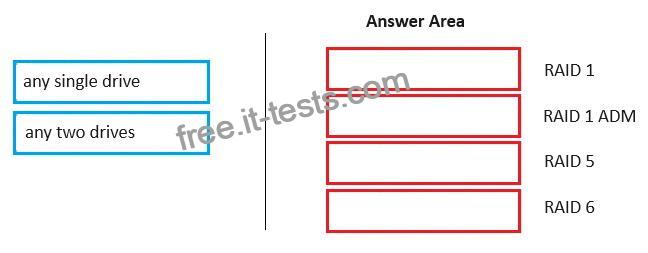
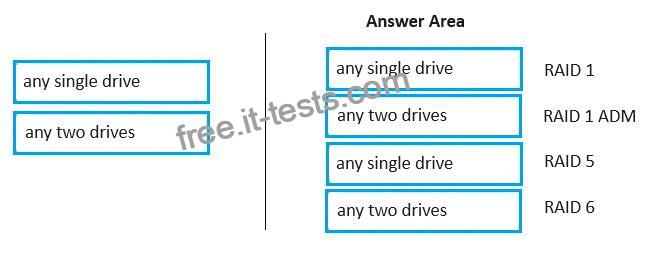
Match the RAID level to the number of drive failures an array can handle without losing data.
(Each option may be used once, more than once, or not at all.)
Explanation:
RAID 1: This is a level of RAID that uses mirroring to create an exact copy of data on two or more disks. It can tolerate the failure of any single drive without losing data, as long as the other drive is still functional.
RAID 1 ADM: This is a level of RAID that uses advanced data mirroring to create two copies of data on three disks. It can tolerate the failure of any two drives without losing data, as long as the third drive is still functional.
RAID 5: This is a level of RAID that uses striping with parity to distribute data and parity information across three or more disks. It can tolerate the failure of any single drive without losing data, as long as the other drives can reconstruct the data from the parity information.
RAID 6: This is a level of RAID that uses striping with double parity to distribute data and two sets of parity information across four or more disks. It can tolerate the failure of any two drives without losing data, as long as the other drives can reconstruct the data from the double parity information.
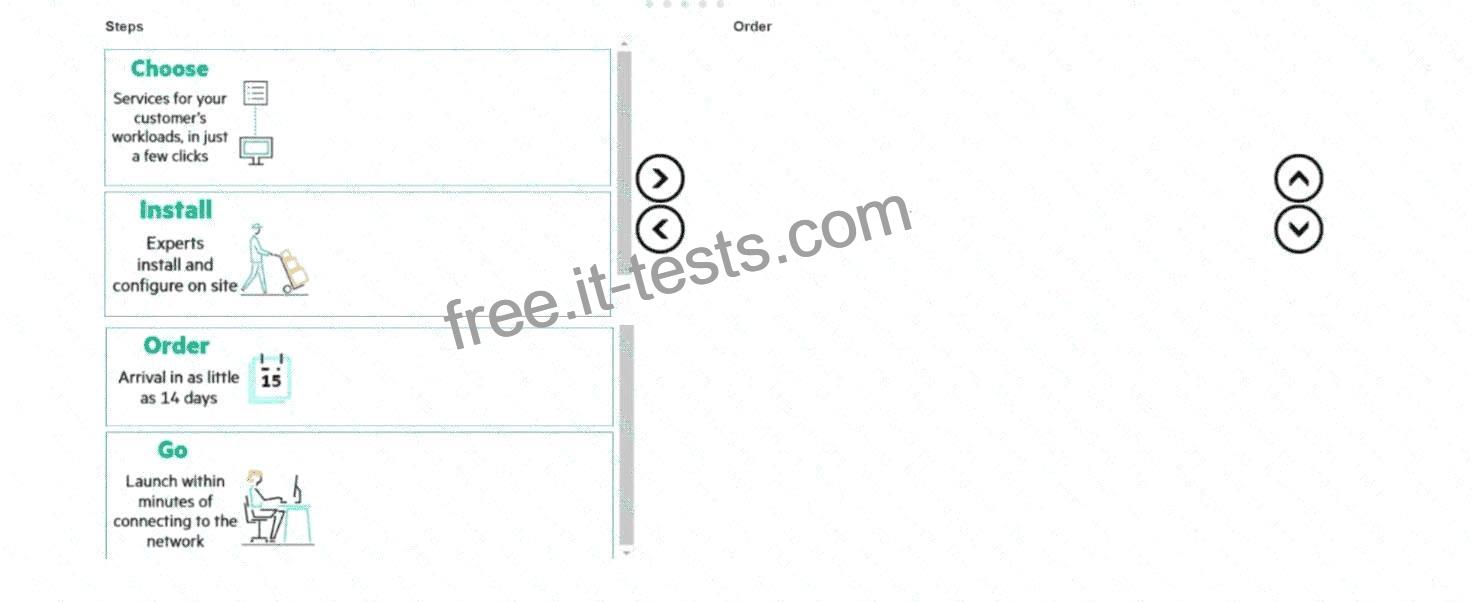
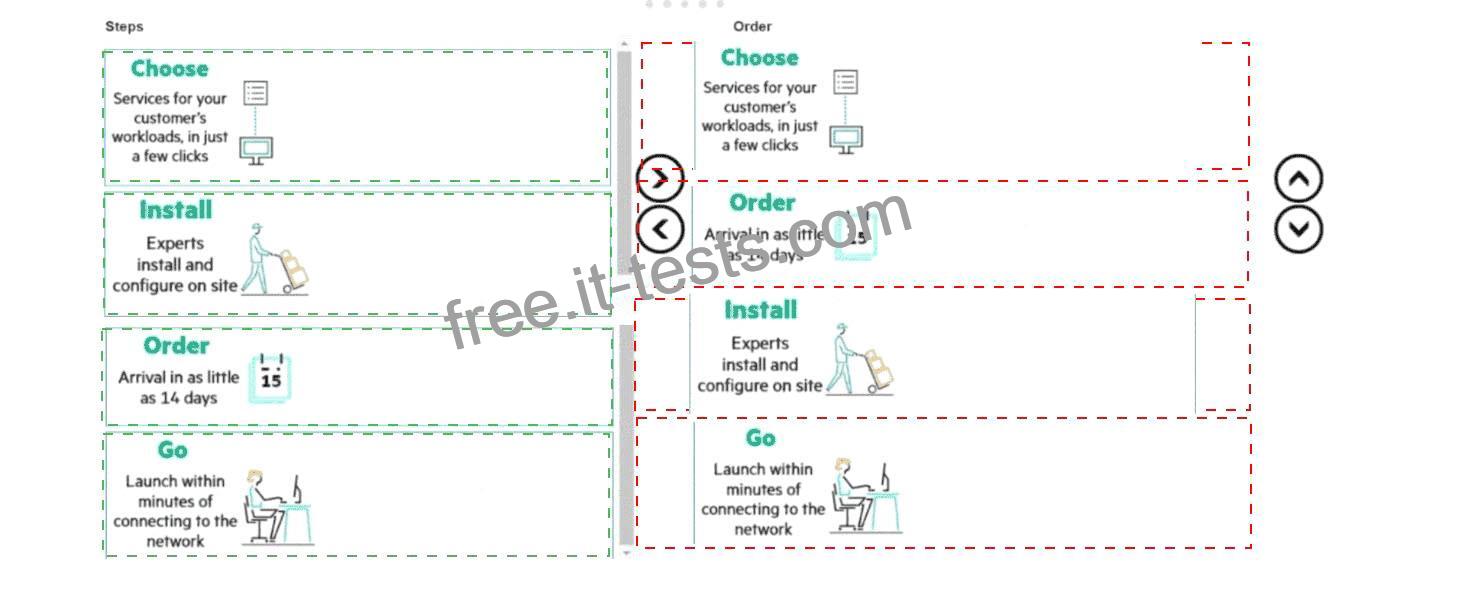
NO.28 Place the HPE Simplified IT for User Illustration in the correct order.
Explanation:
Choose: Services for your customer’s workloads in just a few clicks.
Order: Arrival in as little as 14 days.
Install: Experts install and configure on site.
Go: Launch within minutes of connecting to the network.
Choose: The first step involves selecting the appropriate services for the customer’s workloads through an easy, user-friendly interface.
Order: Once the services are chosen, the next step is to place the order, which promises delivery within a short time frame of 14 days.
Install: Upon arrival, experts will install and configure the services on-site to ensure everything is set up correctly.
Go: After installation and configuration, the services are ready to be launched, often within minutes of connecting to the network, making the process seamless and efficient.
NO.29 Your customer needs to accelerate the performance Of theirDL380 Gen10 servers running workloads on more active cores athigher Clockfrequencies. The customer wants to know if Core Boosting willhelp.
What advice Should you provide?
Explanation
Core Boosting technology uses a relaxed and optimized turbo profile that adapts the processor to specific use cases, configurations, and environments. Core Boosting processors take advantage of extra server power and thermal headroom provided by an innovative HPE voltage regulator design and by cooling technologies.
Consequently, systems that have Core Boosting processors can alleviate common setbacks and maximize processor computing power.
However, Core Boosting option is only supported in ProLiant Gen10 servers with certain Intel processors1
. The HPE ProLiant DL380 Gen10 server data sheet lists the supported processors for Core Boosting as:
* Intel Xeon Gold 6148 Processor (20 core, 2.4 GHz, 27.5 MB L3 cache)
* Intel Xeon Gold 6154 Processor (18 core, 3.0 GHz, 24.75 MB L3 cache)
* Intel Xeon Gold 6152 Processor (22 core, 2.1 GHz, 30.25 MB L3 cache)
* Intel Xeon Platinum 8168 Processor (24 core, 2.7 GHz, 33 MB L3 cache) Therefore, if your customer’s DL380 Gen10 servers are running workloads on more active cores at higher clock frequencies, they can benefit from Core Boosting technology if they have one of these supported Intel processors.
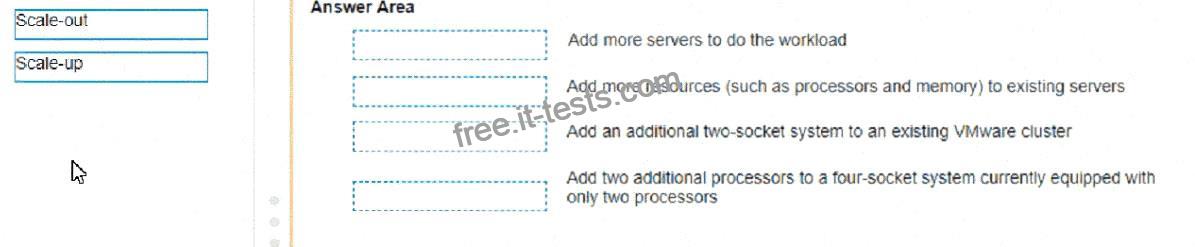
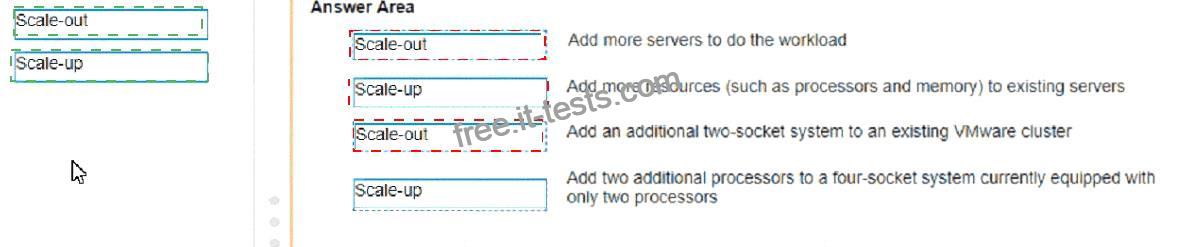
NO.31 Match the correct scaling approach to each strategy
Explanation:
Scale-out: Add more servers to do the workload
Scale-up: Add more resources (such as processors and memory) to existing servers Scale-out: Add an additional two-socket system to an existing VMware Cluster Scale-up: Add two additional processors to a four-socket system currently equipped with only two processors This is because:
Scale-out: This is a scaling approach that involves adding more servers or nodes to a system to increase its capacity and performance. It is also known as horizontal scaling. It can help distribute the workload across multiple servers and improve availability and fault tolerance.
Scale-up: This is a scaling approach that involves adding more resources (such as processors, memory, storage or network) to an existing server or node to increase its capacity and performance. It is also known as vertical scaling. It can help improve the performance of a single server and reduce the complexity of managing multiple servers.
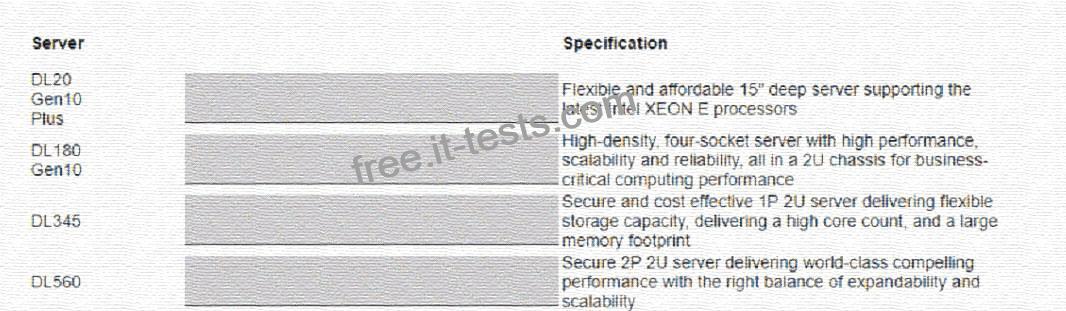
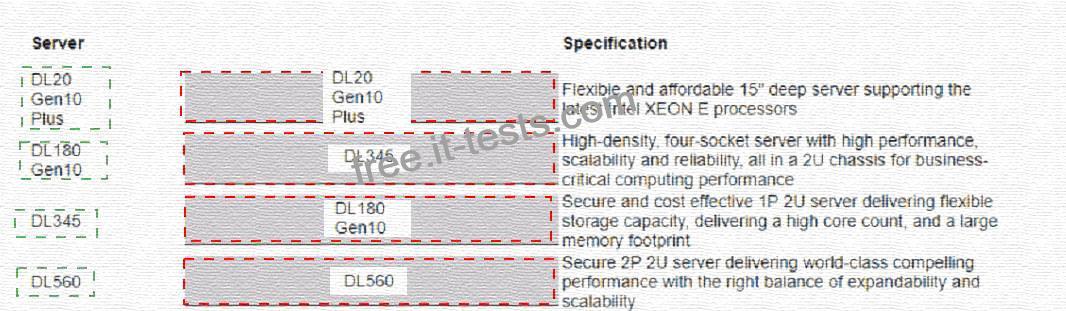
NO.33 Match the HPE server models With the appropriate specification.
Explanation:
The DL20 Gen10 Plus is a flexible and affordable 15″ deep server supporting the latest Intel XEON E processors12.
The DL180 Gen10 is a secure and cost effective IP 2U server delivering flexible storage capacity, delivering a high core count, and a large memory footprint12.
The DL345 is a high-density, four-socket server with high performance, scalability and reliability, all in a 2U chassis for business-critical computing performance12.
The DL560 is a secure 2P 2U server delivering world-class compelling performance with the right balance of expandability and scalability12.
NO.36 Your customer needs to accelerate the performance Of their DL380 Gen10 servers running workloads on more active cores at higher Clock frequencies. The customer wants to know if Core Boosting will help.
What advice Should you provide?
Core Boosting technology uses a relaxed and optimized turbo profile that adapts the processor to specific use cases, configurations, and environments. Core Boosting processors take advantage of extra server power and thermal headroom provided by an innovative HPE voltage regulator design and by cooling technologies.
Consequently, systems that have Core Boosting processors can alleviate common setbacks and maximize processor computing power.
However, Core Boosting option is only supported in ProLiant Gen10 servers with certain Intel processors1. The HPE ProLiant DL380 Gen10 server data sheet2 lists the supported processors for Core Boosting as:
Intel Xeon Gold 6148 Processor (20 core, 2.4 GHz, 27.5 MB L3 cache)
Intel Xeon Gold 6154 Processor (18 core, 3.0 GHz, 24.75 MB L3 cache)
Intel Xeon Gold 6152 Processor (22 core, 2.1 GHz, 30.25 MB L3 cache)
Intel Xeon Platinum 8168 Processor (24 core, 2.7 GHz, 33 MB L3 cache)
Therefore, if your customer’s DL380 Gen10 servers are running workloads on more active cores at higher clock frequencies, they can benefit from Core Boosting technology if they have one of these supported Intel processors.
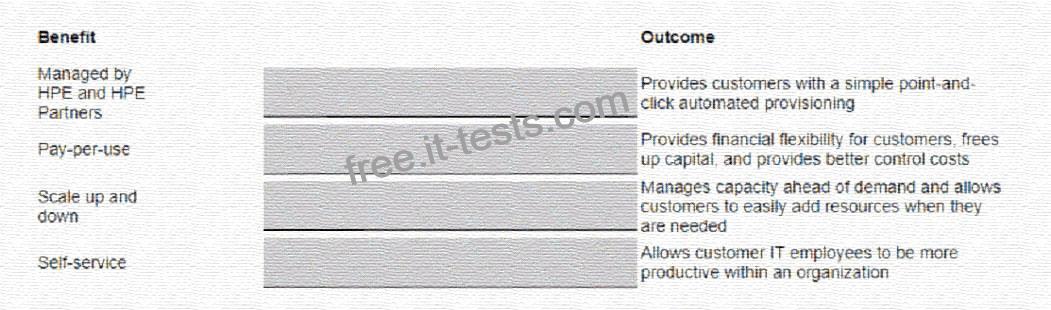
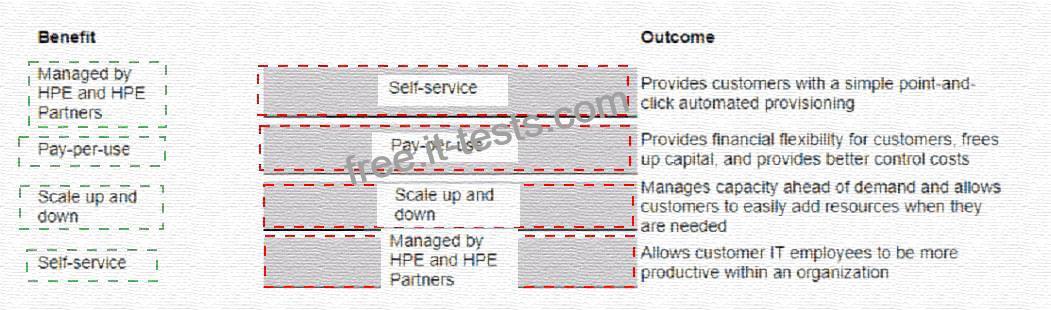
NO.37 Your customer asks you to explain the benefits that the HPE GreenLake consumption model can provide.
Match the GreenLake benefits to their outcomes.
Explanation:
Managed by HPE and HPE Partners: Allows customer IT employees to be more productive within an organization Pay-per-use: Provides financial flexibility for customers, frees up capital, and provides better control costs Scale up and down: Manages capacity ahead of demand and allows customers to easily add resources when they are needed Self-service: Provides customers with a simple point-and-click automated provisioning
https://www.hpe.com/psnow/doc/a00029675enw?jumpid=in_lit-psnow-red
https://www.techtarget.com/searchdatacenter/feature/What-is-HPE-GreenLake-and-how-does-it-work
https://www.turn-keytechnologies.com/blog/article/how-hpe-greenlakes-consumption-model-is-transforming- networks/


